Microsoft Edge Bugs and Omissions

I tweet about the new Microsoft Edge browser quite a lot. I wanted to have a blog post to collect some of the feedback I’ve provided so I have it in one place and can update as needed.

Note: This post mostly focuses on the bad parts of Edge; there are plenty of good parts, including much improved standards support and a safer default security posture.

Last Update: November 2015 Update Most of the trivial issues are fixed; the bigger problems are mostly unfixed

Bugs

1. The “Should I trust this site” link in the HTTPS trust badge goes to page that doesn’t even attempt to answer that question. Update: Sorta fixed.

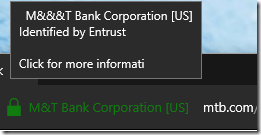
2. The hover “tooltip” on that site doesn’t do escaping of & properly and also has a text-truncation bug:

image Update: Fixed.

3. The RichText tests at www.browserscope.org hang the browser.

4. When Windows UAC is set to “Don’t dim my desktop”, launching a download (e.g. setup.exe) that requires elevation causes the consent window to appear behind the Edge window, effectively causing a denial-of-service condition that hangs the tab.

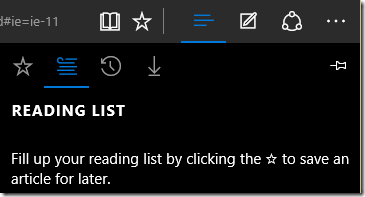
5. No, not that star, the other one!

image

6. Remember focus rectangles that show which button is active? Yeah, I miss those.

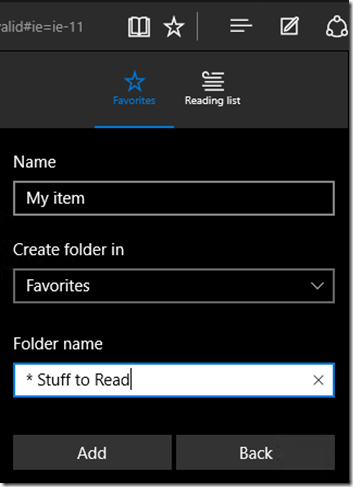
7. Adding a folder silently fails if the name chosen contains any “special filesystem characters” like ?, :, *, etc.

image

8. HTML5 Drag/Drop — You can’t drag/drop files into the browser (e.g. on OneDrive.com). Update: Fixed.

9. Microsoft Edge fixed the longstanding (and amusing, due to its root cause) bug whereby it exported HTTP Archive (HAR) files as XML instead of JSON. Unfortunately, the new JSON exporter omits the required encoding=”base64″ attribute when including binary bodies. Also unfortunate, F12 doesn’t write the creator version field in the JSON; a proper version number here would allow tools like Fiddler to better accommodate the buggy output.

10. CSS Animations that have been offloaded to the GPU (“independent animations”) cannot be stopped. The only workaround is to prevent them from being independently animated.

Omitted

1. Windows 7 Support – After strongly hinting that IE11’s successor would run on Windows 7, the team changed course and said that Edge wouldn’t appear on Windows 7 at release but they’d promise to “watch customer demand” for a Windows 7 version. From both mind-share and market-share perspectives, I think this is a very risky move.

2. Extensions – Edge was expected to contain a new Chrome-like extension model, but this slipped from the original release. There’s currently no ETA for its arrival. Update: Delayed to 2016.

3. Tracking Protection Lists –  A Tweet from an IE engineer implies that these will not be coming back to Edge and the future extension model is expected to serve as a replacement. This is unfortunate, as a good TPL dramatically improves the speed at which pages load and significantly reduces the number of pages that can cause the browser to hang or crash.

4. AddSearchProvider – Edge makes it quite cumbersome to add search providers, having removed the AddSearchProvider API supported by IE7-IE11, Chrome and Firefox.

5. Click-to-Play – There’s no way to configure the built-in Flash object to operate in a “click-to-play” manner.

6. Report Phishing – The old “SmartScreen > Report this Site” experience has been removed and replaced with a “Feedback and Reporting” widget that accepts all sorts of feedback about both the browser and the site. It is likely that this experience does not collect the same level of data as the old experience, meaning that some reported phish may escape.

7. Menus & Chords – When Microsoft Office dumped the menus in favor of the ribbon system, they ensured that the old accelerator keys and keyboard chords (e.g. Alt+F,C to “Close tab”) continued to work. Edge makes no such attempt, and thus my muscle memory built up for over a decade now fails.

8. JavaScript Uncontrollable — Unlike nearly every browser, Edge offers no way to disable JavaScript on a per-site or global basis, even to test <noscript> tags.

9. Certificate Inspection — There’s no way to inspect the certificate presented by a HTTPS site.

Bonus Gripes: Windows 10 Issues

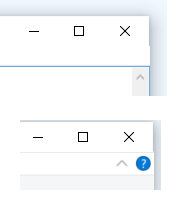
1. At 125% Zoom, the Window Title bar is one pixel too short. (Fixed in August)

Embedded image permalink

2. There’s no visual distinction between the title bar and the menu bar in some apps (like Notepad). As a consequence there’s no way to tell whether click & drag will drag the window or do nothing at all.

3. A background licensing service frequently crashes when resuming from sleep; it takes down the WiFi service which runs in the same service host which means you can’t access WiFi after resume. Update: fixed by the July 20th update.

4. The experience for making applications default has changed again in Windows 10. While the Windows 8/8.1 experience wasn’t awesome, the Windows 10 experience is a slap in the face to the user. Mozilla is complaining, justifiably.

5. Win10/.NET4.6 carries over the Shell/.NET bug whereby double-clicking any label control copies its text to the clipboard. The behavior change in the comctl32 label control was checked in during Windows Vista by a rogue dev without a spec or an explanation.

6. Windows 10 carries over the Windows 8 regression whereby proxy-change calls are ignored during shutdown.

-Eric

Zopfli All The Things

I’ve written about Zopfli quite a bit in the past, and even wrote a tool to apply it to PNG files. For fun, I had a look at one of the most optimized pages in the world: Google.com, through the lens of Zopfli.

Here are the basic resources delivered by the Google homepage:

Zopfli WhatIf

This breakdown shows that Google isn’t optimizing their own compression using the compressor they wrote. The Savings column shows the number of bytes saved by using Zopfli over whatever Google used to compress the asset. Using the default settings in an ideal world, Google could save up to 16.5k, almost 5% of the bytes transferred, by using Zopfli.

I’ve color-coded the column based on how practical I believe the savings to be—the green numbers are the static images where there’s no question the size benefit could be realized. The yellow numbers are cases where script files are compressed; given the complicated query string parameters, I’m betting these scripts are dynamically generated and the compression cost of Zopfli might not be reasonable. The red number is the homepage itself, which probably isn’t reasonable to Zopfli compress as it certainly is generated dynamically.

So, most likely the savings of a practical Zopfli deployment on the homepage page would be about 3.7kb; savings are much greater on other pages on other sites.

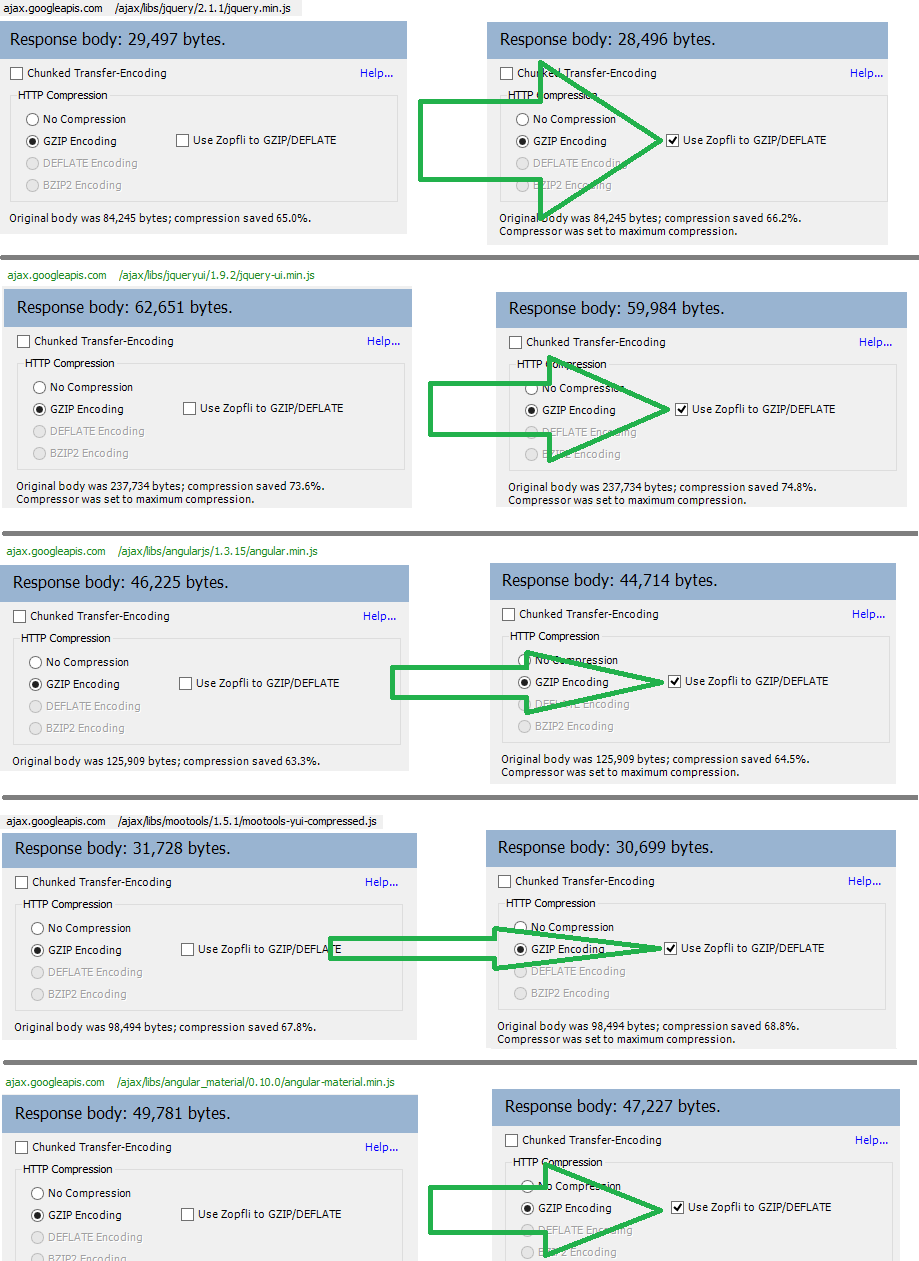
More interesting, however, is the Google API CDN, which hosts scripts for other sites; optimizing these would take a minute or two at most and make every site that uses them faster.

Zopfli savings

Use Zopfli; give the tubes a little bit more room.

-Eric

PS: You may already have zopfli.exe on your system; Fiddler installs a copy to its \Tools\ subfolder!

What I Use–Software Edition

I’ll update this list from time-to-time.

Criteria

The #1 criteria for any software I use is first, do no harm. There’s a lot of great software out there that’s ruined by side-effects, including security problems, performance problems, advertising, and anything else that makes my computer worse for having it installed. In some cases, I’ve simply written my own software (usually uglier and with fewer features) because I’m not willing to compromise on this principle.

What I’m using

Fiddler (free) – For someone who doesn’t really build or test web applications for a living, I still find myriad uses for Fiddler, and I’m always adding more. Current boot count: 13,689.

Chrome (free) – I recently changed my default browser to Chrome on most of my computers. After years of suffering daily crashes in Internet Explorer (known to the IE team, but unfixed), I got tired of waiting for relief. I’m less pleased with Chrome than I hoped to be (their add-ons site is a cesspool of bugs and malware, just like IE’s) but the browser itself is great, and it’s clear that most web developers are building in Chrome first and only later testing in everything else.

Internet Explorer (free) – I use Internet Explorer because it works well with most of the sites I visit, it’s familiar (muscle memory built over a decade), and it supports TPLs, making for a more pleasant browsing experience.

Visual Studio 2013 (commercial) – While I gripe about Visual Studio a fair bit, I can’t imagine using anything else. (I still play with Delphi XE4 once in a while to remind myself how bad things could have gotten.)

SlickRun (free) – This powerful application launcher is one of the first GUI programs I ever built, and it’s now old enough to drink. I’ve modified it over the years to support the latest Microsoft OS’s and hardware (a 64-bit version is now available, for instance) and it remains the first thing I install on every new PC I use. Commands executed: 142,672.

MezerTools (free) – I wrote this simple Software Designer’s toolbox to quickly collect screen-snips, get pixel-perfect measurements (via calipers), and collect color information. You can also quickly convert to/from hex and interact with clipboard text.

Windows Live Writer 2012 (free) – It’s buggy, but better than web-based editors. This tool is on-track to be open-sourced, per Scott Hanselman. Now open-source (minus a few features) as OpenLiveWriter.

Windows Live Mail (free) – No-frills email software with solid integration to Hotmail/WindowsLiveMail/Outlook.com/WhateverItIsCalledThisWeek.

File Locator Pro (trialware, freeware) – Windows has flailed around for almost twenty years trying to create a working file search experience. File Locator Pro (and its free cousin, Agent Ransack) neatly fill the gap with powerful search.

EditPad Pro (trialware, freeware) – My favorite text editor offers high-performance (even on obscenely large files), syntax highlighting, a great hex mode, and much more. A freeware version (EditPad Lite)  is available, but this software is worth buying. I originally thought that its support for FTP/FTPS was utterly ridiculous “feature bloat”. Then my ISP stopped working with Expression Web (FPSE fell out of support with Win2k3’s retirement) so EditPad has become my primary web authoring tool.

Camtasia (commercial) – The industry-leading screen recording software. It has more features than I’ll ever use, and it’s not cheap. But if I had it to do all over again, I’d buy Camtasia immediately and save myself the hours of wasted effort trying to get lesser software to work.

VLC (freeware) – This media player seems to be able to play back everything I throw at it, and gets updated as new formats arise.

Microsoft Word 2010 (commercial) – I wrote my book using Word 2010 and it worked much better than anything else I tried (more on this in a later post). I tried Office 2013 and uninstalled it quickly—beyond the confusingly “extra flat” user-interface, the later version of Office couldn’t handle my book without slowing to a crawl (“background save” locks the UI for 5-15 seconds).

Paint.NET (freeware, be careful) – When Microsoft Paint can’t do the job, I turn to Paint.NET, a powerful alternative. Warning: Be sure to click the right download link, there are many misleading advertisements on the download page. Also, note that it does a terrible job encoding PNG files, so be sure to recompress them.

Axialis IconWorkshop (trialware) – When I need to build icons, this tool takes the pain away.

Start8 (trialware) – Makes Windows 8 and Windows 8.1 bearable.

7-zip (freeware) – Archive compression and decompression software.

Day One (Mac, commercial) – Journaling software, with the right mix of beauty and power.

-Eric

Google Search Provider in Microsoft Edge

Back in the IE7 days, I built a simple Search Provider Builder that allowed IE users (and later users of other browsers) to add custom search engines to their browser without any changes to the site. Trivia: This hour-long little prototype soon led to a formal effort to put this tool on the IEAddons site; the PM for that project was a new hire who eventually married me. :-)

Microsoft Edge has decided to change course and break the AddSearchProvider API used to add custom search providers based on user-initiated actions. The API works in IE7-IE11, Firefox, and Chrome, but not in Edge. Instead, search providers can only be “discovered” by sites that advertise them. (For the avoidance of doubt, let me say explicitly that I think this is terrible; if you agree, vote here).

For now, you can workaround the Edge browser limitation by visiting this page: Install Edge Search Providers for Google, DuckDuckGo, Wikipedia, and Amazon.

Two other changes were made as a part of the Edge search changes:

  1. Search provider URLs must be HTTPS (yay!)
  2. Search providers may not provide Search Suggestions. All Search Suggestions now come from Bing (boo!) over HTTPS (yay)

-Eric Lawrence

Update: Feb 6, 2017 — This post is still accurate for the very latest Microsoft Edge Insider’s Build 15025.