Attack Techniques: SMS Gift Card Scams

Last week, I had the chance to fly to Redmond to meet my new teammates on the Protection team in Microsoft Defender. I also had the chance to catch up with a few old friends from the Edge team, one of whom I met for coffee on Friday morning.

As we sat down with our coffee, she received a text from the CEO of the small startup where she now works, requesting that she go to a Target or Apple Store to grab some gift cards for a partner they were working with. While she’s got a job in senior management, at startups, everyone pitches in to help out with any task.

I don’t have time for this right now…” she mused, and I was excited to note “Well, that, and it’s a scam,” a smug security smarty-pants.

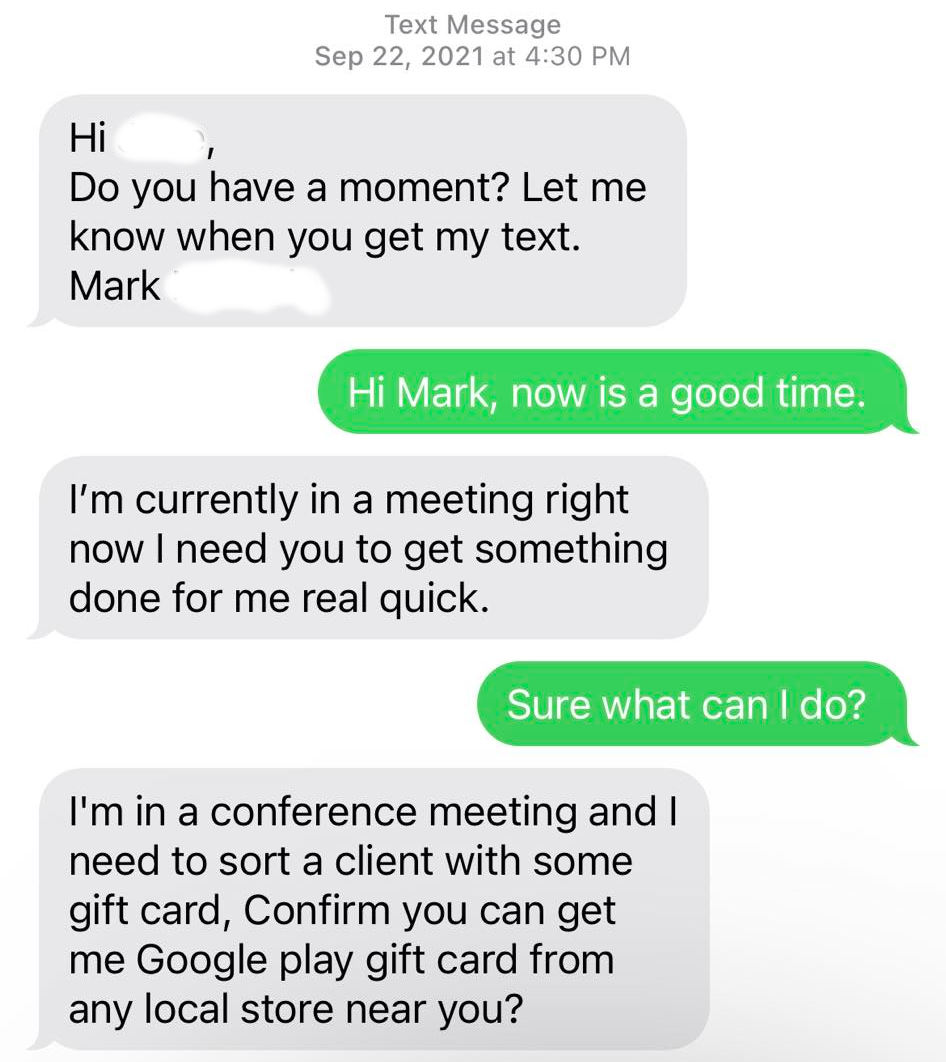
I immediately recognized the true nature of the situation for two reasons: first, it wasn’t my CEO with a time-sensitive request, and second, because another friend was targeted by exactly the same scam. She’d received a SMS text message “signed” by her CEO, asking that she go buy some Google Play gift cards and respond with the codes:

Mark’s organization was large enough that the request was more obviously unnatural, and she’s always on guard for scammers, having grown up in a variety of scam-rich environments.

The attacker in this case only needs a few things: the name of a senior leader with budget approval, names of target employees, their phone numbers, and a throwaway account from which to send the lure. Sometimes this recon information is sourced from data breaches, and sometimes it can be determined from employment sites and other public sources.

The attacker can blast out text messages to dozens or hundreds of potential victims at once. While any given attack is only likely to yield hundreds of dollars, it’s a low-investment attack for the bad guys. Like similar attacks via our phones, these attacks evade URL reputation security scanners. Better still, attackers don’t have to find a way to convert credentials into money — they get the gift card codes which they can immediately convert into either merchandise or sell to unsuspecting buyers.

Why bother with an attack like this?

Because the scam works, even against very smart people — it’s not a question of intelligence. Attackers follow the well-trod social engineering path:

  • create a sense of urgency,
  • abuse our desire to be useful to our bosses,
  • subvert the trust we’ve built with our colleagues, and
  • exploit our limited ability to authenticate the source of our communications.

Stay safe out there!

-Eric

Kilimanjaro – Getting There

My kids and I flew from Austin to Maryland on Friday, June 23rd, and spent a day getting them settled in with their grandparents as I finished collecting a few last-minute essentials for the adventure. My brother and I had a few last-minute conversations about gear (“How many rolls of TP should we bring? Do I have room for this LED lantern?“) and got excited as the hours ticked away.

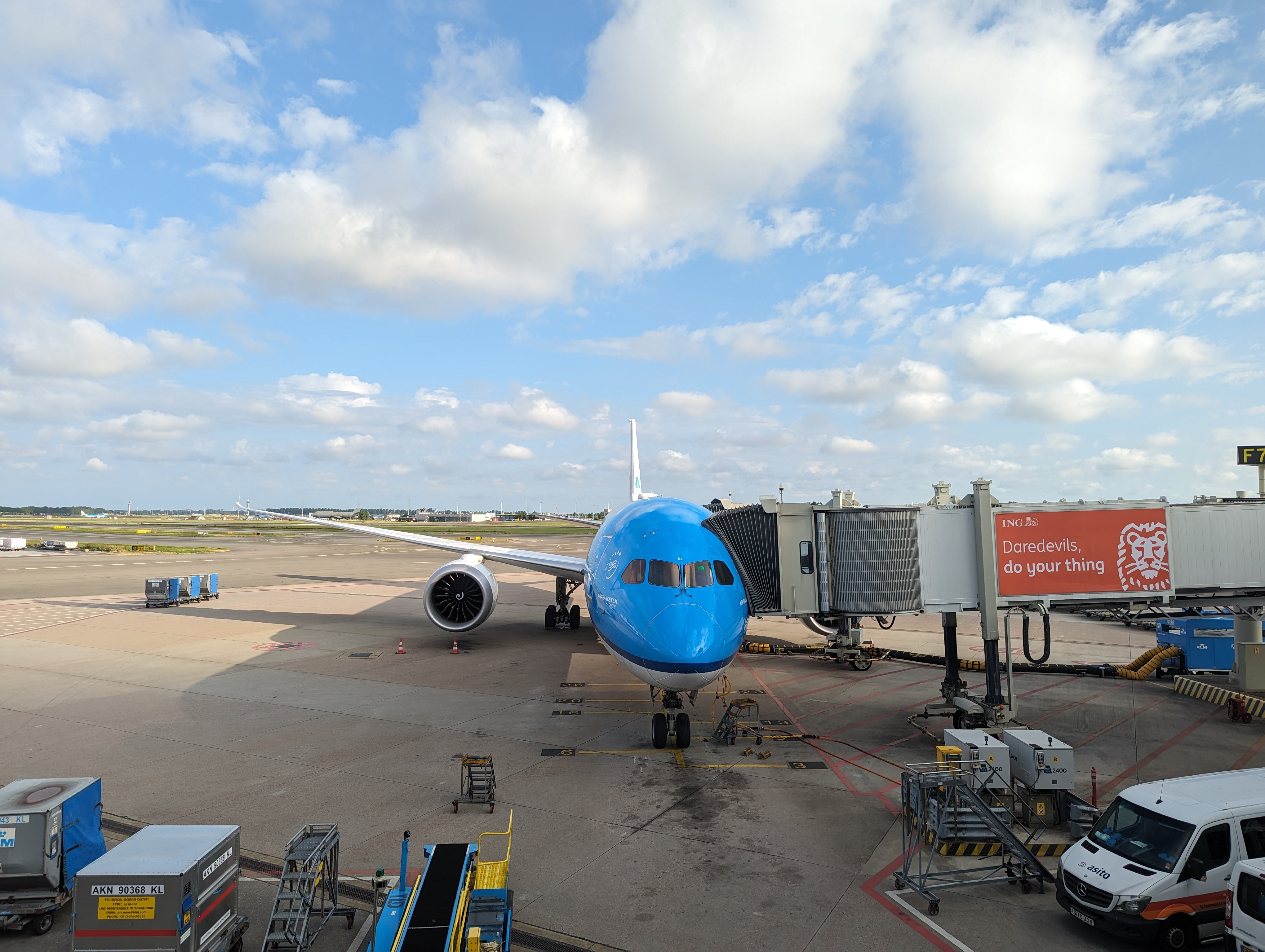
The evening of Sunday, June 25th, our transatlantic flight to Amsterdam was set to depart from Dulles Airport (IAD) near Washington D.C. We were delighted to discover that Dulles was nearly empty, managing to clear check-in and security in under 30 minutes. Since we’d arrived at the airport almost three hours early, we had plenty of time to grab a coffee at Peet’s, chat, and look at our ride:

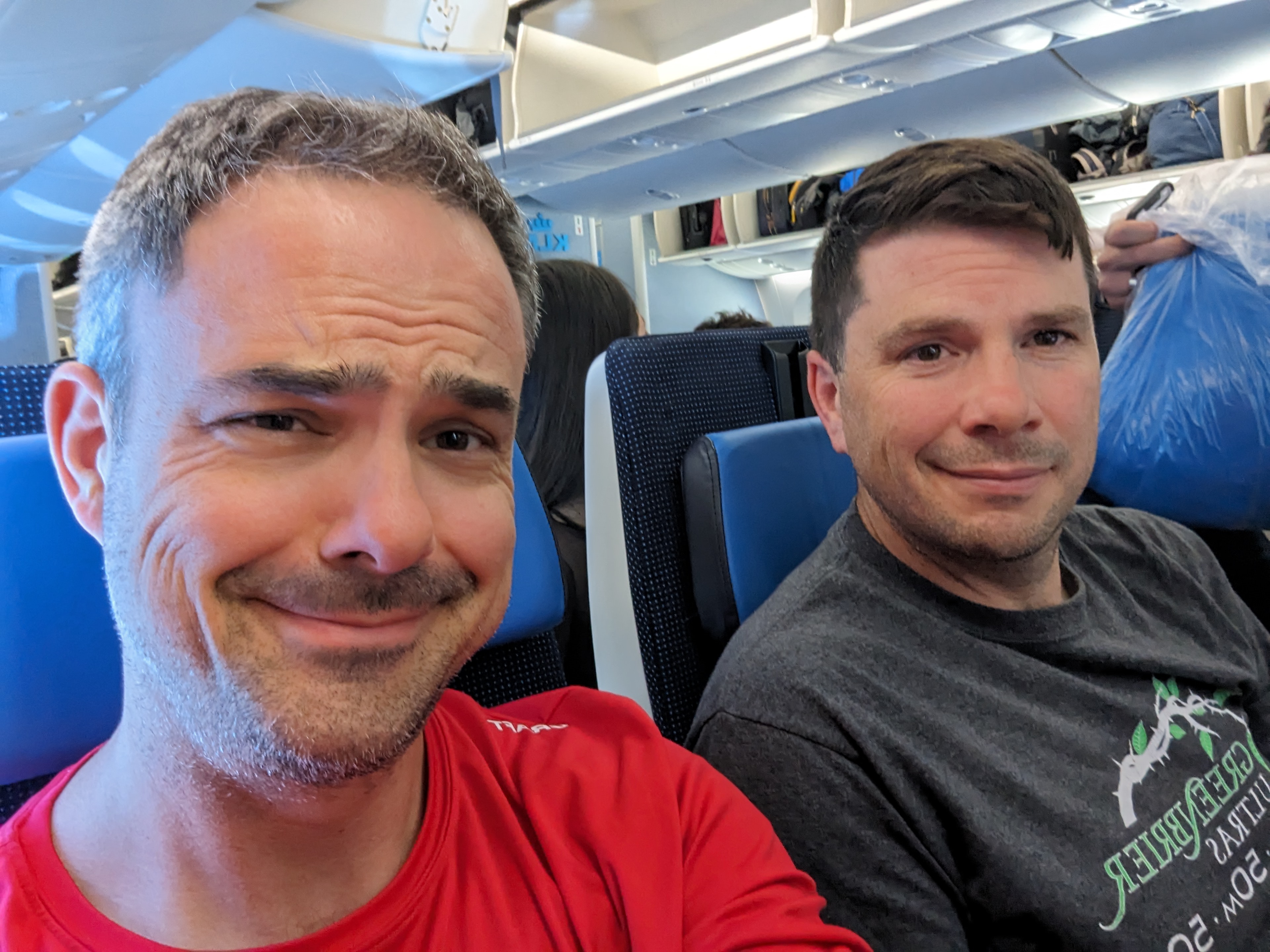
We boarded our Airbus A330 around 5pm. We’d paid for an upgrade to “Comfort Plus” seats, so we were in the front row of the economy section with a few feet of legroom between us and the bulkhead.

Shortly before takeoff, we got the good news that favorable winds would shorten our flight time by almost an hour, but moments later the pilot came on to announce that we’d have to wait on the runway because all takeoffs were paused due to problems with communication between air traffic control and planes. He mentioned that the plan was to send one plane up to check communications and if that went well, the airport would reopen.

Not long after that, he announced that we were first in line for takeoff and I wondered “Wait, are we the guinea pigs?” An hour and nine minutes after leaving the gate, we took off uneventfully at 6:40pm and were finally on our way.

While I’d planned to watch a bunch of movies and TV on the flight, I instead mostly ended up reading Longitude, a book about the race to find a reliable means for sailors to determine their longitude while crossing the ocean throughout the 15th and 16th centuries. I periodically looked up from my book to the GPS-powered flight display showing our progress over the sea, a feat made possible by hundreds of years of scientific ingenuity.

As an international flight, we got a pretty nice dinner:

Thanks to six hours of timezone difference, our delayed 8 hour 9 minute flight arrived in Amsterdam at 7:40am on Monday morning. After a layover of a few hours, we switched over to a 787 for the 8 hour 42 minute flight to Kilimanjaro Airport (JRO), taking off at 10:38am.

Our seats weren’t quite as nice on this second flight, but by this time I was a bit of a zombie. I finished reading my book and zoned out in a half-awake state.

Our flight path seemed strangely indirect, until we noticed that the plane was carefully avoiding flying over Sudan, whose airspace had been closed since a coup in April.

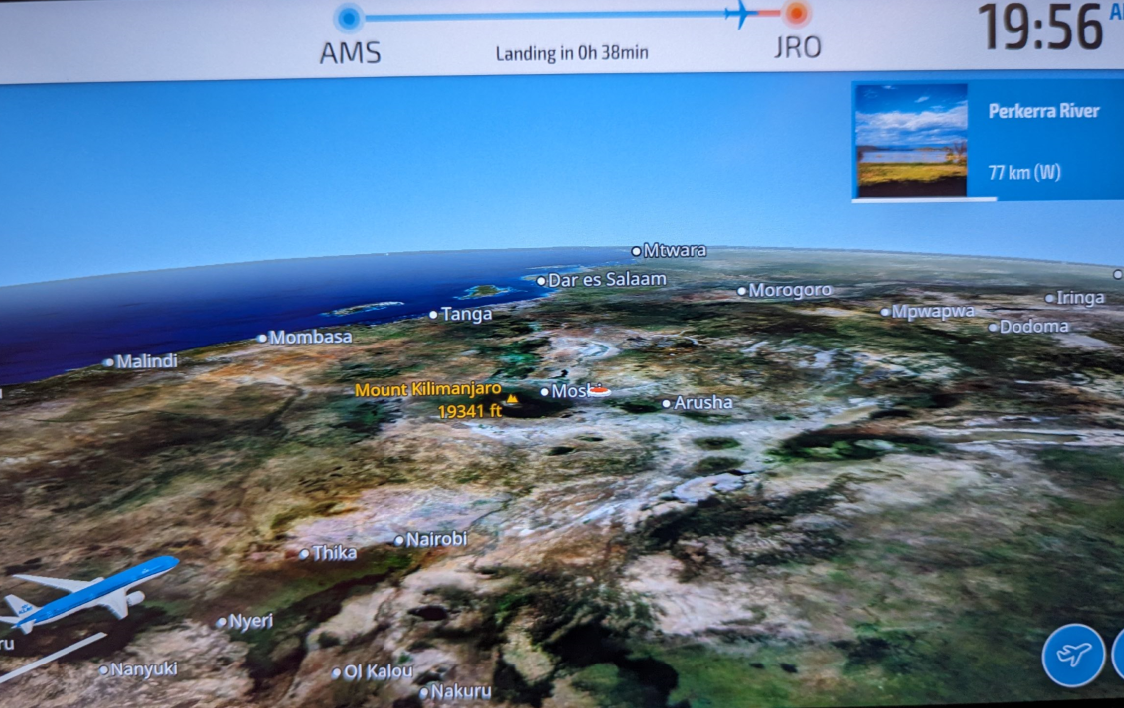
Unfortunately, our arrival was 90 minutes after sundown, so we didn’t get even a tantalizing glimpse of Kilimanjaro, beyond what we saw on the map screen:

After having boarded the A330 around 5pm Sunday night Virginia time, we finally disembarked from our 787 around 20:15 Kilimanjaro time.

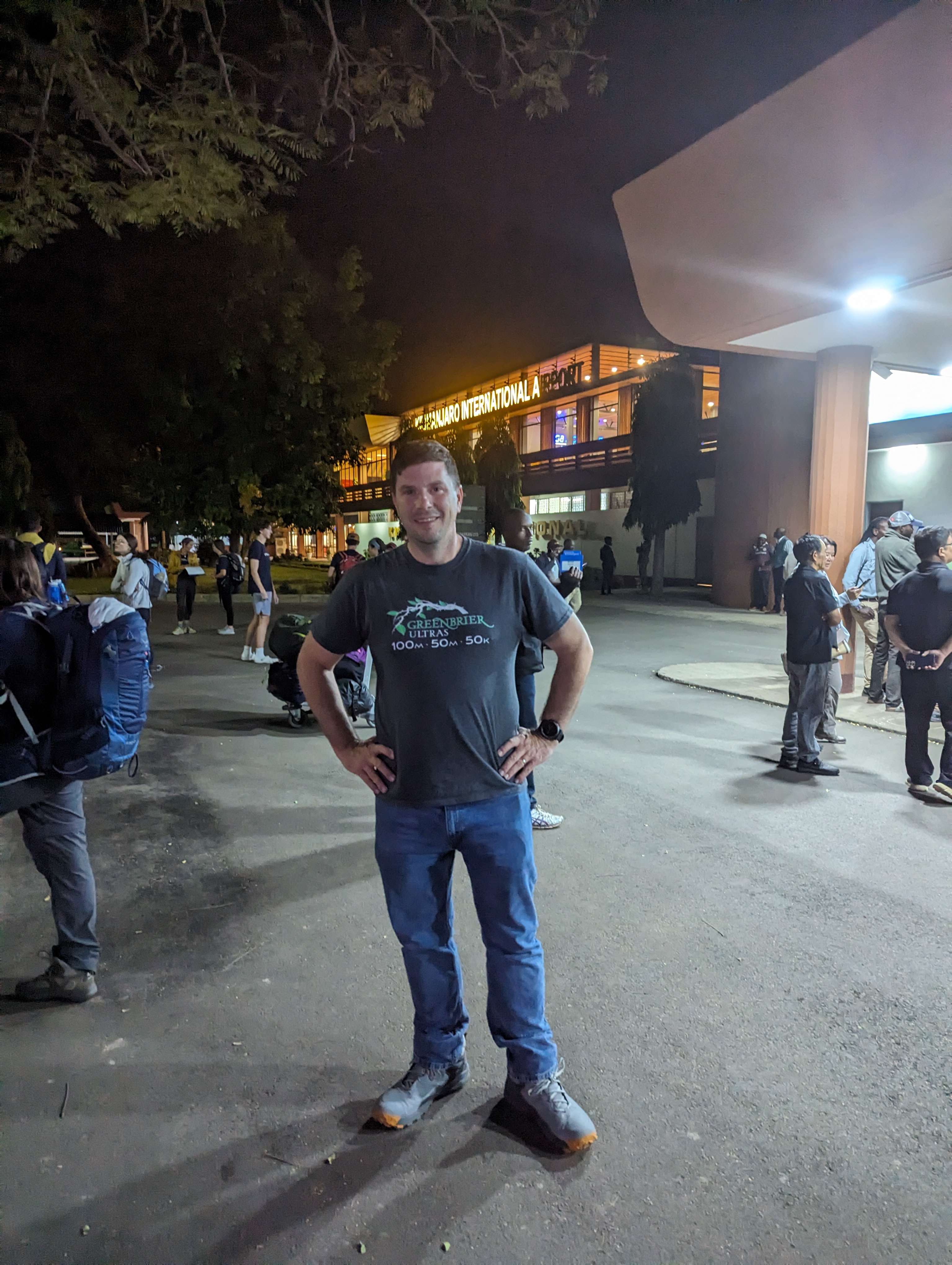
It took almost an hour to clear immigration, collect our duffel bags (which had arrived, thankfully!), and wait for a shuttle bus to the hotel. While we waited, I was amused to listen in on a large group of teenagers who’d all arrived for a trip together, sans parents, as a part of some sort of adventuring group.

A bumpy ten minute ride on the packed shuttle from the airport brought us to our hotel (Planet Lodge), ending the first major part of our journey.

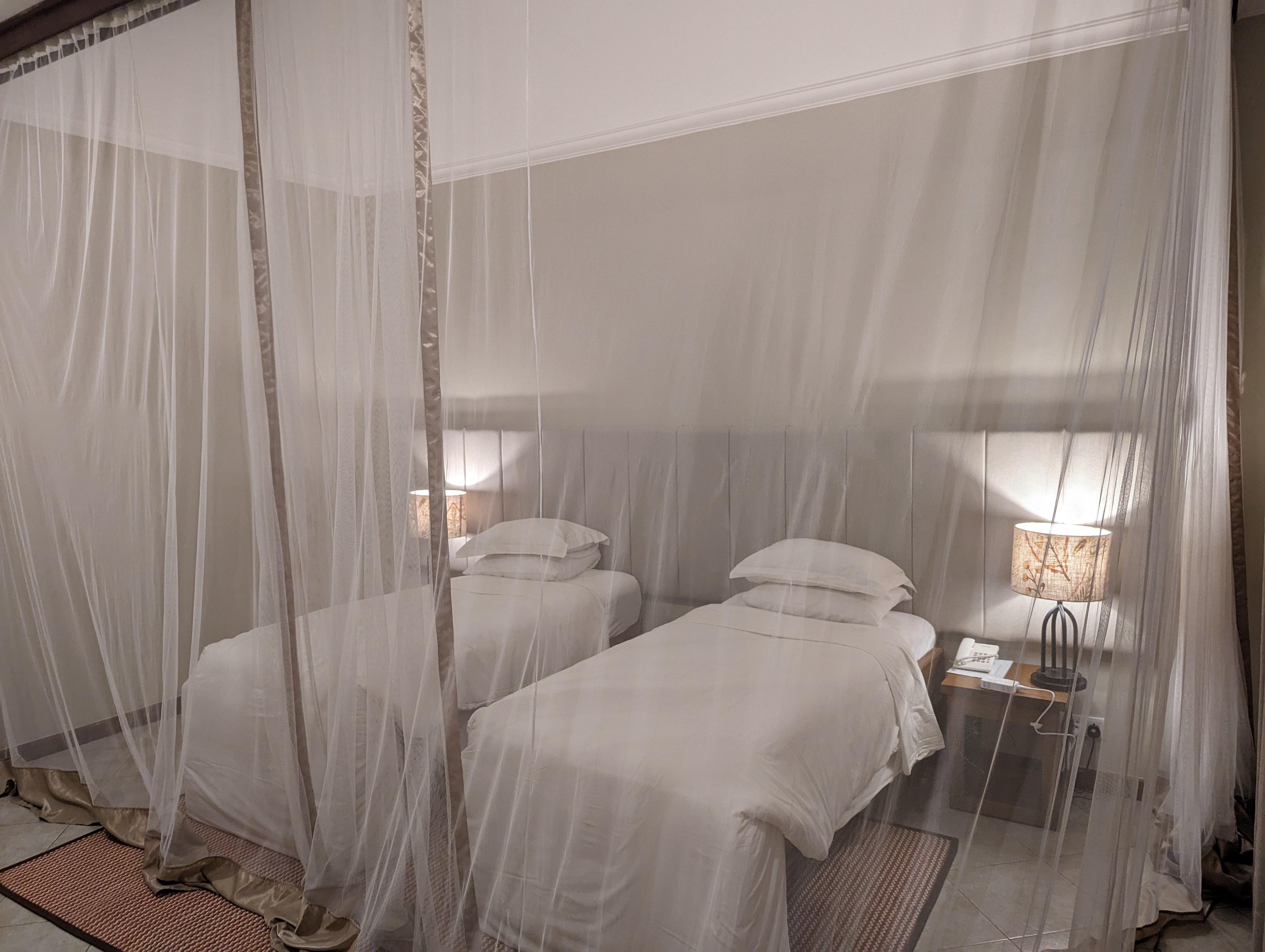
Shortly after checking in, we were shown to our room which took up half of a duplex on the enclosed grounds. While there for a practical reason, as a westerner, the mosquito nets would’ve lent the room a romantic feel were it not my brother in the next bed. :)

I felt both super-sleepy and somewhat energized, but after unpacking a little, scribbling a bit in my journal and brushing my teeth (remembering to use bottled water!), we hit the beds and tried to get some shut-eye in a time zone seven hours from US EDT.

My journal entry concludes: For now, sleep. Tomorrow… adventure!

< Back to Kilimanjaro Journal Index

Kilimanjaro – Journal


Following two previously-posted entries:

…this is an index post with links to the day-by-day journal of my Kilimanjaro trip.

From Gadget’s GPS Tracker. We head East, round the crater, summit, then descend.

I’ve split the posts up by day because the idea of summarizing the entire trip in a single post feels like an endeavor as overwhelming as the trek itself.

Coda: I started publishing these posts on July 27th and finally finished writing on Labor Day weekend, 58 days after reaching Kilimanjaro’s summit. I imagine I’ll be tweaking them for the next few weeks, and I probably need to write some sort of concluding post summarizing what I’ve learned from this adventure and what I hope to do next. But first I have to figure all of that out. :)

Update: I never did get around to writing a concluding post, and instead ended up signing up for another adventure. I’ll be ending 2025 atop Kilimanjaro, trekking Thomson’s Grand Traverse route with a friend. I’m excited to have a reason to get back in shape, and looking forward to seeing the north side of the mountain. Hopefully I’ll pack a little wiser this time and be warm enough to not huddle in my tent quite as much. :)

Thomson’s Grand Traverse Route

Kilimanjaro – Gear

This is the second post in my Kilimanjaro series. The index is here.

When I was initially thinking about signing up for a trek up Kilimanjaro, I had two major areas to think about: my fitness, and all of the stuff I’d need for the trip. I knew that even if I didn’t ultimately take the trek, investing in my fitness would be a great outcome. I also figured that researching, collecting, and breaking in gear would be a welcome diversion from thinking about work and loss, so it seemed like another good reason to take the trek vs. just running races locally or something.

Over the next 18 months, I went from 240lbs to 190lbs (having bottomed out around 180) and dramatically improved my overall level of fitness, primarily by running. I’ve previously written a fair bit about my fitness journey as a part of my ProjectK series.

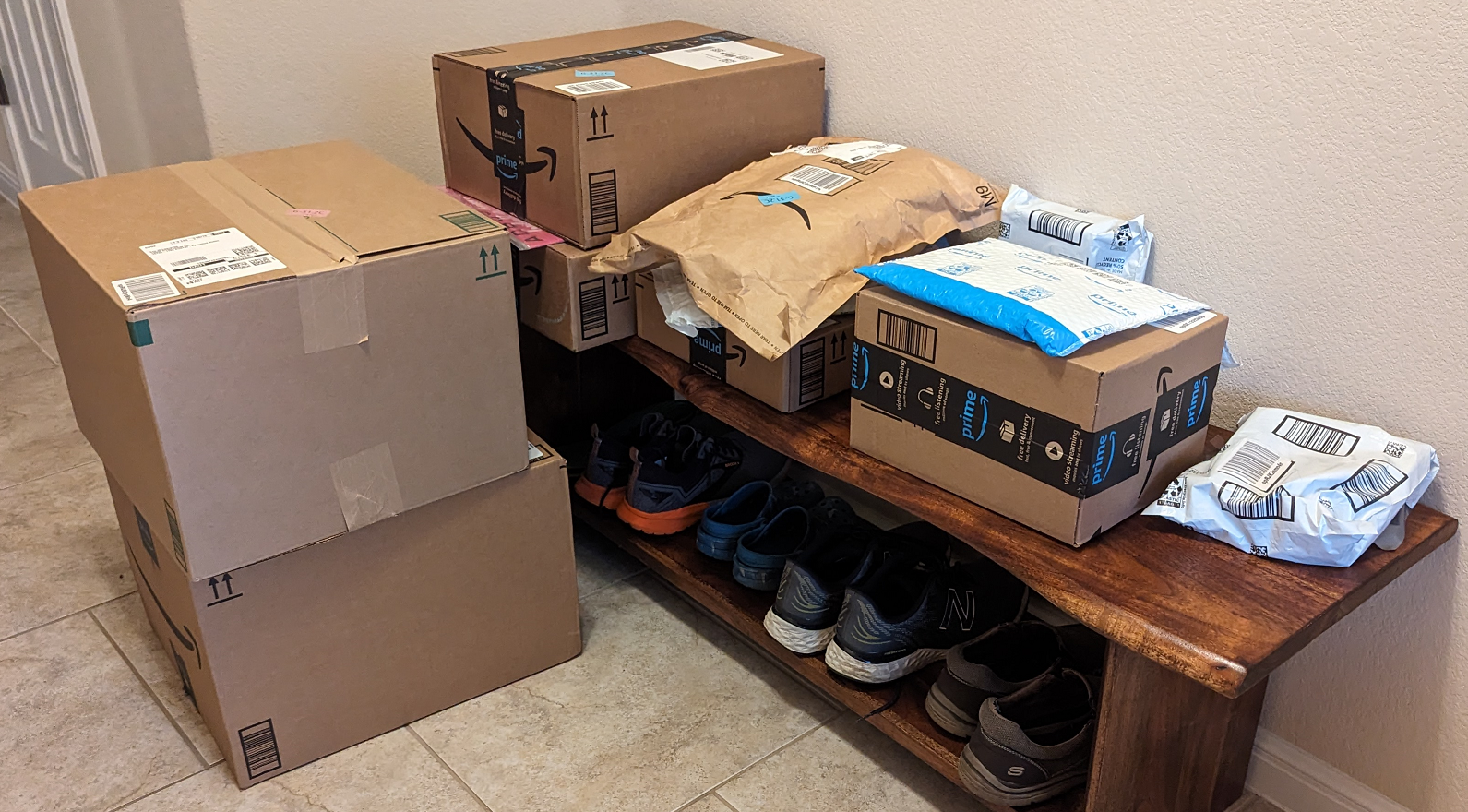
What I didn’t do for most of that time, however, is shop for gear. Early on, I bought and read a few books about Kilimanjaro treks, but I didn’t start buying most of my gear until late May, just about a month before my departure. In the final week, the Amazon driver was dropping a half dozen items at my house every day.

Trekking Kili takes a lot of gear, much of it cold-weather gear and not anything I have on hand after having lived in Texas for the last decade. Even things I thought I had (e.g. socks and underwear) needed to be replaced because it’s important to wear wicking clothing for long hikes. I’d never dreamed that I’d be spending $350 on socks and underwear for this trip!

One factor I didn’t anticipate is how good it feels to have and use the right tool for the job, and that turned out to be a big factor in how I felt about the trip. Where I had the right gear, I felt happy and confident. Where I didn’t, I felt regret and annoyance.

While we were told to plan on bringing a backpack of 30L or more, and a duffel of 140L or more, the true constraint turned out to be weight— porters are forbidden to carry duffels over 15 kilos (33 pounds), and weight accumulates fast. As I took off for Maryland to meet my brother on my way to Tanzania, my duffel was 40 pounds– and that was without any water in the bottles. 😬

In Maryland, I managed to drop just over two pounds (leaving behind clothes for the rest of my vacation after Tanzania, but adding some weight via consumables like protein bars and chocolate). At the bottom of Kili before the trek, I left behind two backpacks full of unneeded gear (power converters, extra clothing), starting the trek with a duffel at exactly the maximum allowed 33lbs.

Ultimately, it turned out that a fair number of my gear choices weren’t needed for the weather conditions of the trek– it wasn’t cold/wet enough to require much of the gear. Layering turned out to be key — on the summit day, I started with 5 layers on top and 3 on the bottom and it went great.

Our tour company provided a packing checklist, but it mostly doesn’t recommend any specific brands or styles and was often frustratingly ambiguous to someone who has spent as little time adventuring as I have.

The following is a list of gear I brought:

montem Ultra Strong Trekking Poles$74The top pick from Wirecutter, these were simple and worked great. I expected we’d only use poles for part of the hike, but in reality we used them for the entire trip except for a few brief sections of rock scrambling, e.g. up the Barranco Wall.
Salomon Quest 4 Gore-Tex Boots$172Perhaps my best purchase for this trip. These were absurdly comfortable and I couldn’t help but feel like a confident trekker each time I put them on. I’d worried that I hadn’t broken them in enough (with just ~20 miles in walking around the neighborhood) but I didn’t get any blisters for the entire trek.

While some of our team hiked in mid cuts, the fact that these were high ankle boots meant that no rocks/pebbles/etc ever got in my boots so I had no need for gaiters.
Boot InsolesA gift, I didn’t end up using these except for the one day before the summit, where they didn’t seem to offer meaningful comfort beyond the already-comfortable boots.

On summit day, they didn’t fit with my super-thick socks, so I took them out and didn’t use them again.
Merrell MOAB 2 Hiking Shoe $90I bought these shortly before the trip with the intention of wearing them for the first few days of the trek and in camp.

I didn’t end up bringing them after I realized that I was never going to make weight with them in my duffel. Ultimately, I think my full-size boots were more comfortable anyway.
My 5yo CrocsI ended up wearing Crocs as my “camp shoes.” The traction was awful (and I should’ve brought fully enclosed ones given the dirt/dust), but they were light and worked okay.
DarnTough Merino Wool Socks$150
/6
Absurdly expensive but awesome. I could’ve easily done the whole hike with 3 or 4 pairs.

I’d bought some liner socks to augment these (for warmth/sweat) but never bothered using them.
Smartwool Mountaineer Socks$26These were my most “bulky” socks. I wore them to the summit, but they were no better than the DarnTough socks and I didn’t wear them again.
Qezer 0F Sleeping bag$165Reasonably compact, and not too heavy. I didn’t end up using it in full “mummy” mode most nights, but it was warm enough anyway.
IFORREST Sleeping Pad$69Pretty comfortable after learning that I’d over-inflated it on the first night.

The side-rails on this pad were probably unnecessary and the overall weight-to-value ratio was probably questionable.
Eagle Creek Duffel$116This was a great bag — super-sturdy and extremely water-resistant. At 133L, it was slightly smaller than the 140L+ bag we were told to bring, but I later noticed that a branded version of this bag is the only one that our tour company sells in their shop.
Frelaxy Dry sacks 3L, 5L, 10L, 15L, 20L$32Very useful for keeping my duffel under control, although I probably should’ve gotten just two sizes (e.g. 5L and 15L)
Well made, but expensive, and I wasn’t disciplined about what went where, so I spent a lot of time hunting for things.
Frelaxy Compression Sack 30L$20I bought this to store dirty laundry. Ultimately the 30L size was much bigger than I needed given how much rewearing I was doing; I should’ve gotten the 18L version.
Osprey Talon Pack 33L$165This bag came highly recommended and I liked it a bunch, although I probably could’ve gotten away with the 26L variant. I liked this one because it could hold my hydration reservoir and it had holders for my poles, but I did not end up using the latter.

My brother carried the 22L version, which was too small.
Osprey Reservoir 2L$38While a bit cumbersome to get into my pack, this worked pretty well and I ended up using it almost exclusively over the Nalgene bottles we carried.
Nalgene bottles $63
/4
We were told to bring four of these. I never used more than 2, and mostly didn’t use them at all in favor of my reservoir.

That said, I did not do a good job with water on the trip and was technically dehydrated for most of it.
Osprey Raincover$30A bit expensive and I ended up needing this only on the last day, but it helped a lot and worked great.
Canon Rebel T7$600While one tour company noted “Our guests have never regretted bringing a high quality DSLR“, bringing this camera was probably my biggest mistake.

While it has a nice telephoto lens, the camera was big, heavy (several precious pounds), comparatively fragile, and its bulk and complexity meant that I usually didn’t have it out of the bag while hiking.

It was useful on the mini-safari day because we were far from the zebras and giraffes, but the telephoto was mostly pointless while on the mountain. Worse, I got a spec of dirt on the sensor at some point, so many of my photos have a smudge at the top. :(

I’d hoped to take some cool photos of the night sky, but I never got around to learning how to use the advanced modes for this camera and failed in this task.
Camera batteries and charger$26I worried about my camera running out of battery, so I bought a USB charger and extra batteries. I needn’t have bothered– after taking over a thousand pictures, the Canon still claimed that its stock battery was full.
Google Pixel 6 ProI kept my Pixel powered-off for most of the trek to save battery, but it took some decent photos and was useful for texting once we got above the treeline and had intermittent service.

My brother brought his new Samsung Galaxy S23 which took very good pictures, including an absolutely bonkers telephoto of the Uhuru Peak sign from the Stella Point sign (~3000 feet away).
iPad Mini 6I used this to watch movies on the flight over and many nights, my brother and I would watch an episode of the Simpsons in our tent before falling asleep. I never ran down the battery with light use. Probably not worth the weight/fragility given that I could’ve used my phone.
EINSKEY Sun Hat$18Great buy. The sun on Kili is relentless and the cool temperatures mean that it’s easy to get burned without realizing it until too late. I wore this giant hat to minimize the need for sunscreen and neck protection.
ELLEWIN Folding baseball cap$11Great buy. While I wore my big hat while hiking for sun protection, I wore this one pretty much non-stop otherwise. (I couldn’t wash my hair for 9 days 😬). I bought three more after coming home.
ALLWEI International Travel Adapter$42This power adapter looked great on paper (flexible, lots of sockets, many plug adapters), but proved a total waste. Our hotel had USB charging ports, and this adapter didn’t work in most of the sockets (and I could never figure out why).
Power Bank 30,800mAh LCD Display Power Bank$23I like that this power bank showed the remaining charge, but it didn’t seem to hold as much as claimed.
Anker PowerCore Slim 10000mAh Power Bank$18This two year-old power bank powered our tent light for almost the entire trip.
BigBlue 28W Solar Panel$71While I love solar, and this wasn’t totally useless, for the bulk and weight I’d’ve been better off leaving this behind in favor of an extra battery pack.

In theory, I could hang this on my backpack while hiking with the included carabiners, but since I was doing that with my heavy camera bag it would’ve made my pack even more cumbersome. So instead I just set it up atop my tent when we made camp.

I’ve been using this panel at the kids’ flag football practices/games — it sits nicely atop my shaded folding chair.
6.5′ LED light strip$11I brought these to light the tent and they worked well for that task. Amusingly, I also wore the light strip as a necklace on the final morning because I’d misplaced my headlamp.
Red LED Flashlight$9Great – Good battery life, limited impact on night vision, lightweight and trouble-free.
HeadlampA fancy gift from my brother, powered by either a rechargeable battery or AAA batteries.

It seemed to work well, but I only used it twice — once on a trip to the toilet tent, and once for two hours on the pre-dawn summit morning. There ended up being a sorta funny story about that.
Pike Trail Gaiters$32These worked okay, but proved redundant because I was wearing high-ankle boots. I didn’t wear them after the first day. Ultimately, I left them in Tanzania after the hike.
Ice Spikes$16I was excited to use these “YakTrax” that strap spikes over the bottoms of boots for hiking on ice and snow. Alas, we never got closer than half a mile away from anything frozen (except a few puddles in the shade). Ultimately, I lamented wasting the weight and I left them in Tanzania after the hike.
IRONLACE – Paracord 550 Laces Type III Boot Laces 72-Inch$8I really didn’t want to have a disaster where a boot lace broke, so I brought these. I didn’t ultimately need them, but they also would’ve been good for hanging laundry to dry, so I’m glad I had them.
Eddie Bauer 30L collapsible backback$20I’ve used this for a bunch of trips and while it’s not super-light, it’s pretty compact and it’s a “good” non-flimsy backpack. I used this to hold the stuff that I was leaving at the bottom and not bringing up the mountain.
4Monster collapsible 32L backpack$29This backpack weighed almost nothing and took up almost no space. It was an excellent “leave behind” backpack but unlike the Eddie Bauer one, I wouldn’t want to actually use it as a backpack for long.
Smartwool Merino 250 Cuffed Beanie$32Expensive, but comfortable and warm.
Merino Wool Balaclava$29Many of our group wore these a lot, but I only wore mine during the summit descent to keep the dust out of my nose. A bit pricey for how little I used it.
MERIWOOL Merino Wool Thermal Pants$64Midweight, I wore these every night after the first and they kept me comfortable.
MERIWOOL Long Sleeve Shirt$64Midweight, I wore this every night and it kept me warm. I wouldn’t’ve survived the trip without this.
MRIGNT Heavyweight Long Johns Set for Extreme Cold$46I didn’t end up wearing these, although they were soft and looked comfy/warm, if a bit bulky.

Lacking any plausible scenario for wearing them after the trek back home in Texas, I’d planned to leave the set behind in Tanzania but accidentally took them home. Ah well.
BALEAF Hooded Shirt
$26This was a great hooded hiking shirt and I wore it for two or three days. I wish I’d brought more. The hood and thumbholed-sleeves were useful for times when I didn’t want to bother with sunscreen.
Under Armour Men’s Tech 2.0 ½ Zip Long Sleeve$39
/2
These were light and comfortable, although they didn’t have hoods, and I preferred the Baleaf shirt overall.
Columbia Tamiami II Shortsleeved Shirt$36This was my most “safari” looking shirt and I like how it looked. That said, I ended up wearing long-sleeves for most of the trip for sun protection.
5 Pack Men’s Active Quick Dry Crew Neck T Shirts$43
/5
Cheap, comfortable and nice looking. I didn’t wear them on the trek often due to the short sleeves, but I wore on the rest of my vacation.
BAMBOO COOL Men’s Underwear boxer briefs$77
/8
Great. I wore these almost every day.
adidas Boxer Briefs$46
/6
I bought a bunch of these and they were okay.
Smartwool Merino 150 Boxer Brief$44By far the most expensive underwear I’ve ever owned. ($44/pair?!?!). They seemed nice, but I didn’t wear them.
Outdoor Ventures Rain Pants
$32I didn’t need these until the summit day, when they kept me warm as windpants pre-dawn, and then again on the last day as it drizzled. Ultimately, I really liked these pants (especially because they zipped from the bottom too, enabling taking them off without removing my boots). Alas, they got muddy on the last day and I somehow managed to either drop them or forgot them on the Land Rover.
North Face shell jacket[est $120]This was a very nice waterproof shell that weighed almost nothing but provided excellent protection from the rain and wind; I got it as team swag while at Microsoft but had never worn it before. It has a hood, zippered pockets, and zippered vents under the arms.
Patagonia “Nano Puff” jacket
STY84212
[est $220]Also (expensive) Microsoft swag, this turned out to be one of the “MVP” pieces — not only was it a critical layer for warmth every night at dinner and on the summit day, it also folded into one of its own pockets and served as my pillow from night 2 onward.
Free Soldier Waterproof Hooded Military Tactical Jacket$57I had expected this to be my “heavy” coat that I’d wear to the summit. In practice, it provided almost no warmth, and I left it behind when I left Tanzania.

I liked how this jacket looked (and that I could put my 1991 Space Camp flight suit’s name badge on its velcro). Shame it wasn’t useful.
Free Soldier Fleece Cargo Hiking Pants
$47These were nice and would’ve made for excellent snow pants. However, it never was cold enough to require these while hiking, so I didn’t end up wearing them.
Wespornow Hiking Shorts$43
/2
These were great — light and sturdy. While it was too chilly to wear them as much as I expected, I’ve been wearing them non-stop since returning from the trek.
Free Soldier Hiking Pants$42These were great — comfortable and sturdy, and I wore them a bunch.
Convertible Zip Off Safari Pants$21These were fine hiking pants, although I ended up not needing their convertible feature at all.
Cooling Bandana$16This was very high quality, but I didn’t use it.
Bandanas$22I didn’t end up using any of these, although two women in my group ended up borrowing them to cover their hair or neck.
Outdoor Essentials Running Gloves$13These were excellent — not too warm, but they kept my hands at a good temperature in the chilly weather. I wore them a bunch while hiking even when I wasn’t cold to keep the sun off my hands.
Tough Outdoors Winter Gloves$22These heavy gloves seemed great, but the only time when I wanted to be wearing them (pre-dawn on summit day), they were packed in my duffel because I thought the light gloves would’ve been enough. Oops.
Fisher Space Pen$33Crazy-expensive, but I used this for journaling every day and it did write at any angle and temperature.
GlassesI ended up bringing a total of 4 pairs of glasses on the trip — three pairs of sunglasses and one pair of regular glasses.

I wore one pair of sunglasses (wraparound RayBans) for almost the entire hike, and they worked well with my big hat which reduced the need for the recommended side-shields I didn’t have. I only brought extra sunglasses because I was afraid of breaking or losing a pair, but I certainly didn’t need three pairs.

I brought my regular glasses for stargazing, but ultimately I didn’t really use them due to the cold weather at night.
Katadyn Micropur MP1 Purification Tablets$13I brought these on a recommendation from a Kili hiking site.

Ultimately, I only used them on the first day; the porters prepared our water via either boiling or purification and ultimately I decided that my belly problems were unlikely to be a result of the water (or that double-treating it would be worse).
Loperamide Hydrochloride Caplets, Anti-Diarrheal$3I ended up taking one or two of these most days on the hike.
Malarone (Atovaquone –
Proguanil) Anti-Malarial
$0This is apparently the anti-malarial BillG uses, which was good enough for me. I noticed no side-effects.

I spent a lot of time thinking about mosquitos, but ultimately I think I only got one bite during the entire trip.
After Bite Itch Eraser stick$11
/2
I use these a lot in Texas, but didn’t need them on the trek.
Ben’s 30% DEET Repellent$11We all used this for the first few days before we cleared the tree line.
Diamox (Acetazolamide) Altitude medication$5Pretty much everyone on the trip took this to help with acclimatization at extreme altitude.

I started taking half doses (1/2 pill twice a day) on the second or third day before ramping up to a full dose of two pills per day two days later.

The most common side-effect from this medication is frequent urination which proved annoying during cold overnights. The second most common side-effect is tingling in your fingers and toes– I didn’t encounter this on the half dose, but it was immediate (and felt very odd!) once I started taking the full dose. It only lasted (or I only noticed) for fifteen minutes or so after each dose.
Advil$8I think I may’ve taken two on the whole trip.
Dr. Scholl’s Moleskin Plus Padding Roll $7Seemed like high-quality stuff, but no blisters meant no need for anti-blister tape.
DripDrop Hydration – Electrolyte Powder Packets$28
/32
I’ve used these when running and I like them. I brought them to try to encourage me to drink more water (and mask the kinda chemically taste of treated water). Ultimately, I only used four packets or so.
Neutrogena Ultra Sheer Sunscreen SPF 70$10I liked this. I used it on the backs of my hands, face, and neck when they weren’t covered by clothing.
Coppertone Pure and Simple Zinc Oxide Sunscreen Stick SPF 50$8Tiny and convenient, I used this mostly on my cheeks when I worried that my hat wasn’t providing enough coverage.
Royal SunFrog Tropical Lip Balm SPF 45$8
/2
Great. I wore this long before I thought I needed it and it kept my lips (mostly) in good shape. I somehow ended up with some slight bleeding on the inside of my bottom lip, but it wasn’t a big deal.

PURELL Hand Sanitizer Gel with aloe
$15
/6
My hands have never been as dirty as they were on this trip.
Care Touch Hand Sanitizer Wipes$11While pitched as more convenient than the Purell,
I think I used one of the hundred I bought on the entire trip.
Body Wipes$22
/50
These were big and great. I ended up taking 30 to TZ and only using about 8 of them while trekking. (Eww. I didn’t really smell, I swear!)
Kleenex TissuesMy nose ran for basically the entire trek, but fortunately I’d heard about this and brought Kleenex. Ultimately, I did too good a job of conserving these and only used about one pack of the three I brought.
JUKMO Quick Release Tactical Belt 1.5″ Nylon Web Hiking Belt with Heavy Duty Buckle$21This was a cool belt, but cumbersome– you had to remove the buckle to take it off because it was too big for belt loops. I’d brought it for the heavy snow pants that I didn’t end up wearing. Ultimately, I loaned it to one of our luggage-delayed trekmates.
BIERDORF Diamond Waterproof Black Playing CardsBrought but barely used.
ATIFBOP Biodegradable Dog Poop BagsTechnically, we were supposed to pack out any TP we used on the trail, but fortunately I never had to resort to that. Still, having bags was useful for various reasons and I used about 10.
Master Lock TSA Luggage Lock$8I’ve never flown with a duffel before and I had nightmares of it coming open and spilling all of my gear in some foreign luggage transfer.
Coghlan’s Featherweight Mirror $5Useful for seeing whether you’ve got your sunblock on right.

Fun fact: my trekmates thought it was hilarious when I busted this out for the cinematographer when he was trying to fix his sunblock, and I think it’s what cemented my trail nickname: “REI.”
Smith & Wesson pocket knifeA gift, I didn’t use this often, but it came in handy a few times and it worked well.
Folding Steel Pocket Scissors$7These seemed fine, but I didn’t end up using these at all, using the knife on the rare occasions when I needed to open something.
Sun Company Compass & Thermometer Carabiner$14This was useful to have context on how cold it got overnight, but I didn’t use the compass at all. It was hard to read and photograph though, so I expect to use a different one next time.
Pulse Oximeter$15I ended up owning two pulse oximeters (thanks, COVID-19!) and I brought one so I could check my own numbers in private if I ever wanted to. I only used mine a few times, IIRC, including at Stella Point and Uhuru Peak.
BOGI Microfiber Travel Sports Towel (40″x20″)$8This seemed well-made, but given the low temps, I ended up using it just once.
Polepole: Training Guide for Kilimanjaro book$30A nice training guide for Kili. Had I followed it, I’d probably have found the hike even easier. But just running like a madman for a year ended up working just fine.
The Call of Kilimanjaro book$4
used
A nice and inspiring account of a trek
Kilimanjaro Diaries ebook$6Oops. Never got around to reading this one before the trip. Reading it after, it turns out to be both pretty funny and one of the most informative/complete discussions of what the trip is actually like.
Lonely Planet Tanzania book$21A nice guide, although coverage of Kili and the nearby area is only a small fraction of the book.
Swahili in One Week book$8I wish I could say I’d made more of an effort in reading this but I didn’t do more than skim it.
SwimsuitSwimsuit for the hotel pool
Giant pile of cash for tips$1600American cash, mostly $20s. All bills must be unmarked, undamaged, and less than 10 years old.
The links above are Amazon Affiliate links; any purchases will net me a small commission at no cost to you.

I probably brought a few more things that I’ve since forgotten, but I’ll add things as I remember.

What else did I wish I’d brought?

As you can see from the list above, I brought a bunch of things that turned out not to be very necessary. Looking back, what else do I wish I’d had?

  • Caffeine-free tea, hot cider powder, etc – I ended up drinking a lot more hot drinks than I expected.
  • Inflatable pillow – The Patagonia puffy was much better than nothing, but a small pillow would’ve been worth the weight/space.
  • Collapsible solar lantern – The LED light strip was great and I liked it, but a collapsible solar lantern probably would’ve been simpler and more practical.
  • Compact binoculars – I ended up using my camera’s long-lens for this purpose, but it offered only a narrow field of view and didn’t work as well as a pair of decent binoculars would have.

Next up — my daily journal and lots more photos.

-Eric

Kilimanjaro – Overview

Writing about my Kilimanjaro trek will not be easy: How can I do justice in describing what was:

… all at the same time?

Nevertheless, I’ve been back for a few weeks now and I’m compelled to put fingers to keyboard before life keeps moving on and memories fade.

tl;dr: I made it to the summit at Uhuru Peak, 19341 feet.

First, Some Context

At 19341 feet, Kilimanjaro’s peak is the highest point in Africa (its representative in the Seven Summits). It’s the world’s highest free-standing mountain, and about the highest one can hike without specialized gear or oxygen. It was first summited in 1889, by a German.

It’s located on the border of Tanzania and Kenya.

Thanks to its location just south of the equator, its longest day is within a minute of the shortest. We summitted on July 6, 2023:

The overall summit success rate for Kilimanjaro treks is only around 50%, but that’s primarily because many people try to do it too quickly (e.g. 5 days) and fail to acclimatize to the altitude. Our trek was 9 days via the Western Approach, an itinerary with a historical success rate of 98%.

Expectations

While I’d done some research before booking my trek, and some more before actually embarking, I also avoided high-bandwidth spoilers — I didn’t look at many photos, any videos, or even use Google Maps to look at Kilimanjaro. As a consequence, I had surprisingly few expectations for what trekking Kili would entail, and, for the most part, the expectations I did have were all wrong.

Expectation: The trek would be grueling.
Reality: While it was definitely tiring at times, my legs were sore only one evening. While most of my treadmill runs result in a heart rate of 150-170 for an hour or more at a time, I don’t think my heart rate went over 130 for the entire Kili trip. Most days involved only around 5 hours of slow-paced hiking.

My shoulders got sore at a few points (I haven’t worn a backpack in decades) but nothing major. I felt few effects of altitude (slightly short of breath at times, a minor headache one evening likely a result of dehydration).

My biggest issue (by far) was a persistent gurgling in my belly making me worry that I’d need a bathroom at a time when none was available.

Expectation: I’d be incredibly inspired by views of Kilimanjaro in our two days in Tanzania before the trek started.
Reality: Kili is a very shy mountain, often hidden from nearby cities by cloud cover. In the days before the trek started, we saw no more than a dark smudge above the clouds. When we finally broke through to the plains on the hike, we got our first real views of Kili and that was indeed pretty exciting.

Expectation: I’d be one of the older trekkers in our group.
Reality: Our trekking party numbered ten, ages 40, 40, 44 (me!), 45, 46, 47, 49, 50, 70 (his birthday on summit day!), and 72.

Expectation: The views on the trek would be astounding.
Reality: There were definitely some awesome vistas, but persistent cloud cover (below us for most of the trip!) meant that we mostly only had views of Kili’s peak itself, and the top of Mount Meru as a distant island across the sea of clouds. It’s an impressive mountain, for sure, but not necessarily a lot to look at for days on end.

The “Island” of Mount Meru in the sea of clouds

During the hike, I spent a huge amount of time with my eyes on the ground ahead, deciding where to plant my poles and feet. While we hiked through the forest, there were some neat things to look at, but none seemed especially exotic compared to, say, hiking in Hawaii, or (virtually) running in Belize on the treadmill.

Much of the trek landscape seemed almost lunar — an endless field of nearly lifeless gray dust

Expectation: Given our prolonged schedule (a 9 day trek) there would be a lot of sitting around chatting with my fellow trekkers under a gorgeous field of stars.
Reality: While the sun did indeed go down at 6:30pm every night, a full moon made star-gazing less effective. More importantly, after sundown, the temperature dropped rapidly and precipitously, making the prospect of being anywhere except burrowed into my sleeping bag an unappealing prospect. Beyond that, my (non-sun) glasses remained packed away for almost the entire trip, meaning that when I did go out at night (mostly to use the bathroom tent), the stars were barely visible to my eye. This one was a bummer.

While we definitely got in some great socialization during the trek and at meals, I spent a lot of time in my own head, wandering around taking photos, and writing in my journal.

Socializing in the Chow tent: Breakfast, Lunch, Tea, and Dinner

Expectation: I’d feel a tremendous sense of accomplishment upon reaching the top.
Reality: I felt a sense of relief that I had made it without encountering any major problems. I was tired from a long day of extremely slow hiking, and reaching the top was much less emotional than I expected.

Prep

I’d set out a number of goals/plans to prepare for this trip, but much of the expected prep didn’t really happen.

  1. Get in shape. This I did do, but not in a very well-rounded way. I bought an incline trainer with the expectation of using it to simulate long uphill hikes, but I only did that a few times. 98% of my running was near flat. I never did any practice hikes, nor did I wear my backpack before the trip.
  2. Spend a bunch of time trying and buying gear. While it did indeed take quite a while to find/buy everything, I spent almost as little time as possible on it. I wrote a whole post about this topic.
  3. Get a bunch of vaccinations. It turns out that none are required. While I brought two new medications on the trip (anti-malarial and altitude acclimatization pill), I didn’t get any shots. While there are several recommended vaccines for Tanzania, most are not really needed for Kili hikers.
  4. Learn some Swahili. This seemed like a bit of a stretch but a fun exercise as I’m sadly very mono-lingual. I learned only a few words before the trip. It turns out that English is plenty to get by in tourist areas, but the locals will chat endlessly in Swahili around you and it would’ve been nice to have some clue about what they were saying.

What Went Great

The trek went great for a few reasons, but the top two were weather and people.

Our weather for the trip was basically perfect– sunny most days, and an ideal hiking temperature in the high 50s and 60s. I’d expected Tanzania to be much hotter (especially in our days on the ground before the trek) and the cool weather and altitude meant that I was barely sweaty at all. I’d packed 9 pairs of hiking socks and could’ve easily gotten away with 4. I wore a few of my hiking shirts for several days apiece, and while they got pretty dusty, they too didn’t end up smelly. While the nights got very cold (to my Texas body) dropping into the low 30s with wind, things never got as cold as expected, and I didn’t end up wearing my heavy gloves, boot spikes, or warmest base layer thermals. All told, I probably carried eight or nine pounds of weather-related gear that I didn’t need.

In terms of my trek-mates, I didn’t know what to expect, but was delighted by our group. As mentioned, we skewed older (not surprising as this was a pretty expensive trip) but we had some fascinating characters. Five had US military backgrounds– retired: two Marines, one Army, and active duty: a Navy Commander (a doctor), and an Air Force Lt. Colonel (a transport pilot).

Of us five civilians, there was a legal power couple (an EVP for a financial services company and her cinematographer husband), their college friend (also a lawyer), my brother and me.

Our head guide and trekking team at the Lemosho route’s entry “gate”. I’m in red.

All ten of us had gone in assuming that there’d probably be at least one whiner in the group, but everyone was awesome, even in the face of setbacks. The biggest of those setbacks my brother and I had managed to avoid: Five of our trekmates’ luggage hadn’t arrived by the time we left our pre-trek safari lodge, meaning they’d have to start the trek with only the gear they’d packed in their carry-on backpacks and key items they could rent upon departure. We all tried to share some of our extra pieces as possible (water bottles, handkerchiefs, snacks, sunscreen, bug spray, anti-malarial/altitude medications, etc) and ultimately everyone’s luggage had arrived before the all-important summit day.

Beyond the ten of us trekkers, we also had a huge set of support staff: one head guide, three assistant guides, a chef, a waiter, a handful of personal porters, and almost fifty different porters who brought our tents, duffels, and other infrastructure up the mountain. They were an awesome, hardworking, and kind group who not only made the trek possible but also helped make the trip feel luxurious.

Final Costs

All tips are paid in cash using bills under 10 years old

While Kilimanjaro is not difficult to hike, getting there and going up is not accessible to many people for financial reasons.

When the idea to do this trip first entered my mind, I very roughly swagged it as likely to cost somewhere just under $40,000 total for my brother and I.

In reality, even though we went with a fancy company, the tab came in quite a bit under that guesstimate, although the true cost depends on what you include (e.g. I spent ~$6k on exercise equipment and services while getting in shape).

Total costs for my brother and I together, including myriad taxes:

Guided Trek$13300Thomson Safaris
Tips$1400Guides, porters, drivers, etc.
Carrying this much cash for almost two weeks did not feel comfortable.
Airfare$5694Delta/KLM Economy Plus
($4774 base fare + $920 in “Comfort” upgrades)
Insurance$536$461 airfare insurance, $75 in evacuation insurance
Gear$2600Mostly at Amazon. [Details]
Visas$200Tanzania Tourist Visas
2 Pre-Trek days in Tanzania$1600Including hotel, mini safari, coffee tour
Food/drink$100Most of our food/drink were part of the package
Souvenirs$300A canvas painting, coffee, shirts, fridge magnets, etc.

…for a total somewhere around $25730 for both of us.

Beyond the direct expenses, the trip entailed taking ~10 days off work, and I followed it with a week’s vacation with my family. These three weeks off of work made for my longest break in 22 working years.

To be continued…

This is the first post in a series. You can continue reading here:

Update: I’ve signed up for Thomson’s “Grand Traverse” trek over the last week of 2025.