Edge/Chrome Policy Registry Entries

One of the more common problems reported by Enterprises is that certain Edge/Chrome policies do not seem to work properly when the values are written to the registry.

For instance, when using the about:policy page to examine the browser’s view of the applied policy, the customer might complain that a policy value they’ve entered in the registry isn’t being picked up:
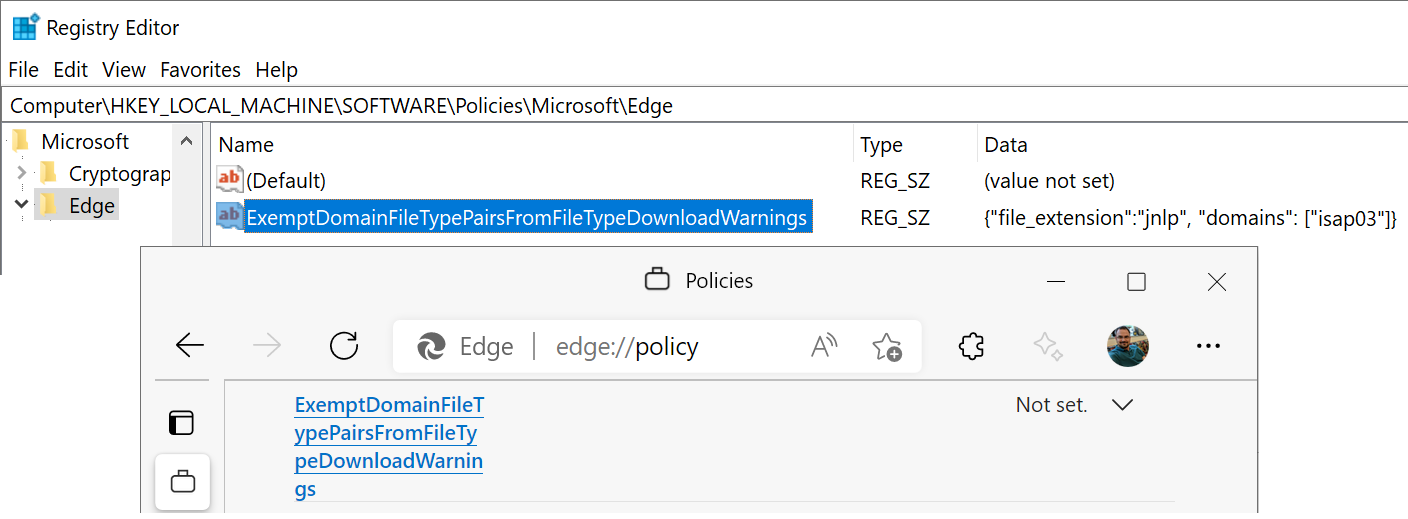
In a quick look at the Microsoft documentation for the policy: ExemptDomainFileTypePairsFromFileTypeDownloadWarnings, the JSON syntax looks almost right, but in one example it’s wrapped in square brackets. But in another example, the value is not. What’s going on here?

A curious and determined administrator might notice that by either adding the square brackets:

…or by changing the Exempt…Warnings registry entry from a REG_SZ into a key containing values:

…the policy works as expected:
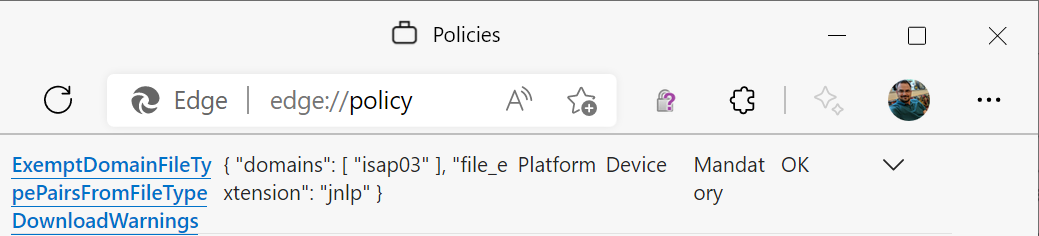
What’s going on?

As the Chromium policy_templates.json file explains, each browser policy is implemented as a particular type, depending on what sort of data it needs to hold. For the purposes of our discussion, the two relevant types are list and dict. Either of these types can be used to hold a set of per-site rules:

* 'list' - a list of string values. Using this for a list of JSON strings is now discouraged, because the 'dict' is better for JSON.
* 'dict' - perhaps should be named JSON. An arbitrarily complex object or array, nested objects/arrays, etc. The user defines the value with JSON.

When serializing these policies to the registry: dict policies use a single REG_SZ registry string, while the intention is that list policies are instead stored in values of a subkey. However, that is not technically enforced, and you may specify the entire list using a single string. However, if you do represent the entire JSON list as a single string value, you must wrap the value in [] (square brackets) to represent that you’re including a whole array of values.

In contrast, if you encode the individual rules as numbered string values within a key (this is what we recommend), then you must omit the square brackets because each string value represents a single rule (not an array of rules).

Group Policy Editor

If you use the Group Policy Editor rather than editing the registry directly, each list-based policy has a Show... button that spawns a standalone list editor:
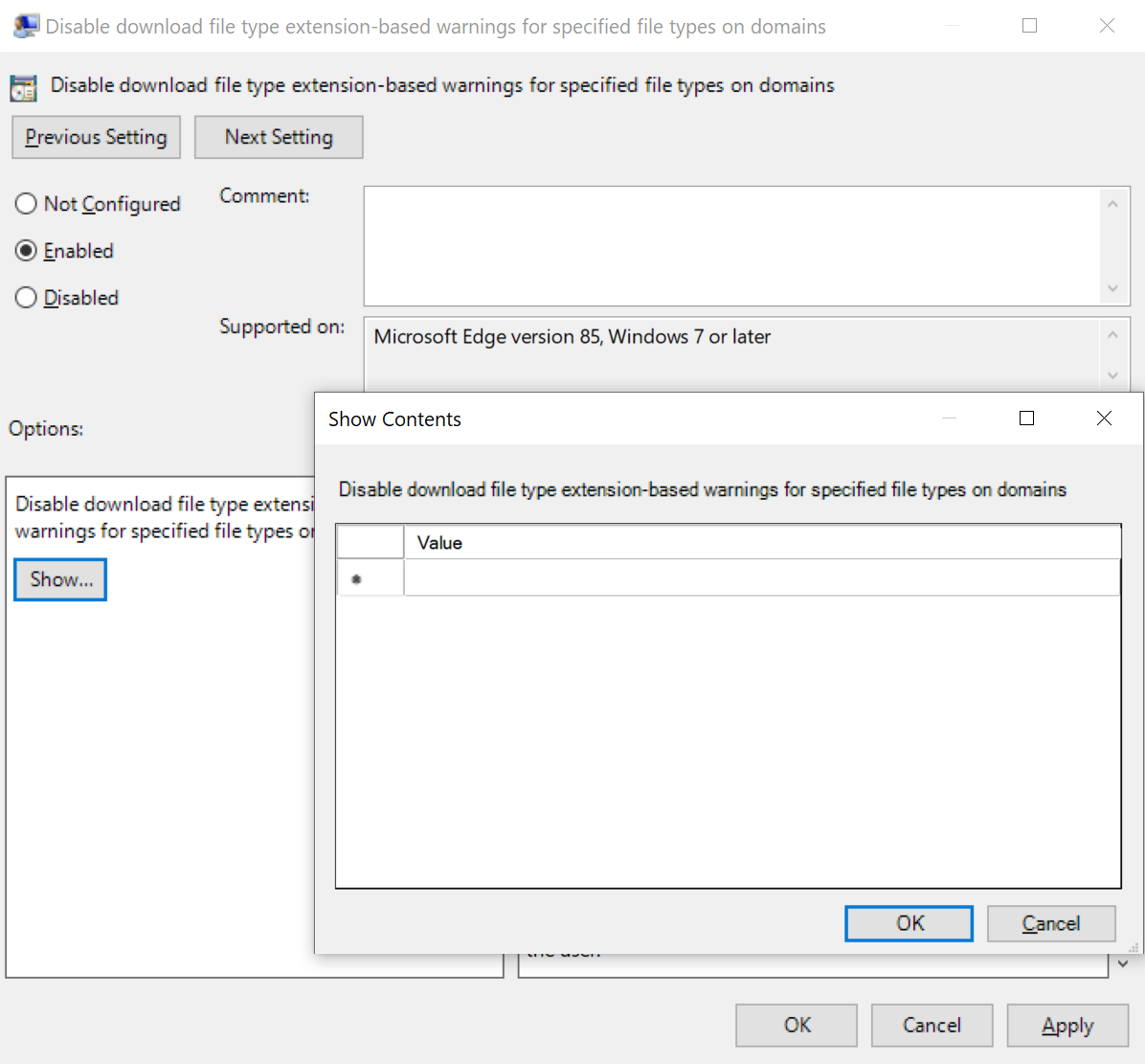
In contrast, when editing a dict, there’s only a small text field into which the entire JSON string should be pasted:

To ensure that a JSON policy string is formatted correctly, consider using a JSON validator tool.

Bonus Policy Trivia

Encoding

While JavaScript allows wrapping string values in ‘single’ quotes, JSON and thus the policy code requires that you use “double” quotes. Footgun: Make sure that you’re using plain-ASCII “straight” quotation marks (0x22) and not any “fancy/curly” Unicode quotes (like those that some editors like Microsoft Word will automatically use). If you specify a policy using curly quotes, your policy value will be treated as if it is empty.

Non-Enterprise Use

The vast majority of policies will work on any computer, even if it’s just your home PC and you’re poking the policy into the registry directly. However, to limit abuse by other software, there are a small set of “protected” policies whose values are only respected if Chromium detects that a machine is “managed” (via Domain membership or Intune, for example).

The kSensitivePolicies list can be found in the Chromium source and encompasses most, but not all (e.g. putting a Application Protocol on the URLAllowlist only works for managed machines) restrictions.

You can visit about:management on a device to see whether Chromium considers it managed.

Case-Sensitivity

Chromium treats policy names in a case-sensitive fashion. If you try to use a lowercase character where an uppercase character is required (or vice-versa), your policy will be ignored. Double-check the case of all of your policy names if the about:policy page complains about an Unknown Policy.

WebView2

The vast majority of Edge policies do not apply to the WebView2 control which is built atop the internal browser engine; only a tiny set of WebView2-targeted policies apply across all WebView2 instances. That’s because each application may have different needs, use-cases, and expectations.

An application developer hosting WebView2 controls must consider their customer-base and decide what restrictions, if any, to impose on the WebView2 controls within their app. They must further decide how those restrictions are implemented, e.g. on-by-default, controllable via a registry key read by the app on startup, etc.

For example, a WebView2 application developer may decide that they do not wish to ever allow DevTools to be used within their application, either because their customers demand that restriction, or because they simply don’t want anyone poking around in their app’s JavaScript code. They would then set the appropriate environment flag within their application’s code. In contrast, a different WebView2 host application might be a developer testing tool where the expectation is that DevTools are used, and in that case, the application might open the tools automatically as it starts.

Refresh

You might wonder when Edge reads the policy entries from the registry. Chromium’s policy code does not subscribe to registry change event notifications (Update: See below). That means that it will not notice that a given policy key in the registry has changed until:

  1. The browser restarts, or
  2. Fifteen minutes pass, or
  3. You push the Reload Policies button on the about://policy page, or
  4. A Group Policy update notice is sent by Windows, which happens when the policy was applied via the normal Group Policy deployment mechanism.

    Chromium and Edge rely upon an event from the RegisterGPNotification function to determine when to re-read the registry.

Update: Edge/Chrome v103+ now watch the Windows Registry for change notifications under the HKLM/HKCU Policy keys and will reload policy if a change is observed. Note that this observation only works if the base Policies\vendor\BrowserName registry key already existed; if it did not, there’s nothing for the observer to watch. For Dev/Canary channels, a registry key can be set to disable the observer. Update-to-the-Update: The watcher was backed out shortly after I wrote this; it turns out that it caused bugs because the way that Group Policy updates work is the old registry keys are deleted, some non-zero time passes, and then the new keys are written. With the Watcher in place, this was causing the policies to be reapplied in the middle, turning off the policies for some time. This caused side-effects like the removal and reinstallation of browser extensions.

Note that not all policies support being updated at runtime; the Edge Policy documentation notes whether each policy supports updates with the Dynamic Policy Refresh value (visualizing the dynamic_refresh flag in the underlying source code).

-Eric
Smarter Defaults by Paying Attention

As a part of every page load, browsers have to make dozens, hundreds, or even thousands of decisions of varying levels of importance: should a particular API be available? Should a resource load be permitted? Should script be allowed to run? Should video be allowed to start playing automatically? Should cookies or credentials be sent on network requests? The list is long.

In Chromium, most of these decisions are controlled by per-site settings that must be manually1 configured by either the user, or administrative policy.

However, manual configuration of settings is tedious, and, for some low-impact decisions, probably not worth the effort.

Wouldn’t it be cool if each user’s individual browser were smart enough to consider clues about what behavior that specific user is likely to want, and then use those clues in picking a default behavior?

User Activation / Gestures

The first, and simplest, mechanism used to make smarter decision is called user-gestures. Certain Web APIs and browser features (e.g. the popup blocker, file download experience, full-screen API, etc) require that the user has interacted with the page before the feature can be used.

This unblocking signal is called a User Gesture or (formally) User Activation.

Requiring a User Gesture can help prevent (or throttle) simple and unwanted “drive by” behaviors, where a website uses (abuses?) a powerful API without any indication that a user wants to allow a site to use it.

Unfortunately, User Gestures are a pretty low hurdle against abuse– sites can perform a variety of trickery to induce the user to click and unlock the protected feature.

Enter Site Engagement

Chromium supports a feature called Site Engagement, which works similarly to User Activation, but stretched over time. Instead of allowing a single gesture to unblock a single API call that occurs within the subsequent 5 seconds, Site Engagement calculates a score that grows with user interactions and decays over inactive time. In this way, sites that you visit often and engage with heavily offer a streamlined experience vs. a site you’ve only visited once (e.g. while you’re clicking around in search results). If you stop engaging with a site for a while, its engagement score decays and it loses any “credit” it had accrued.

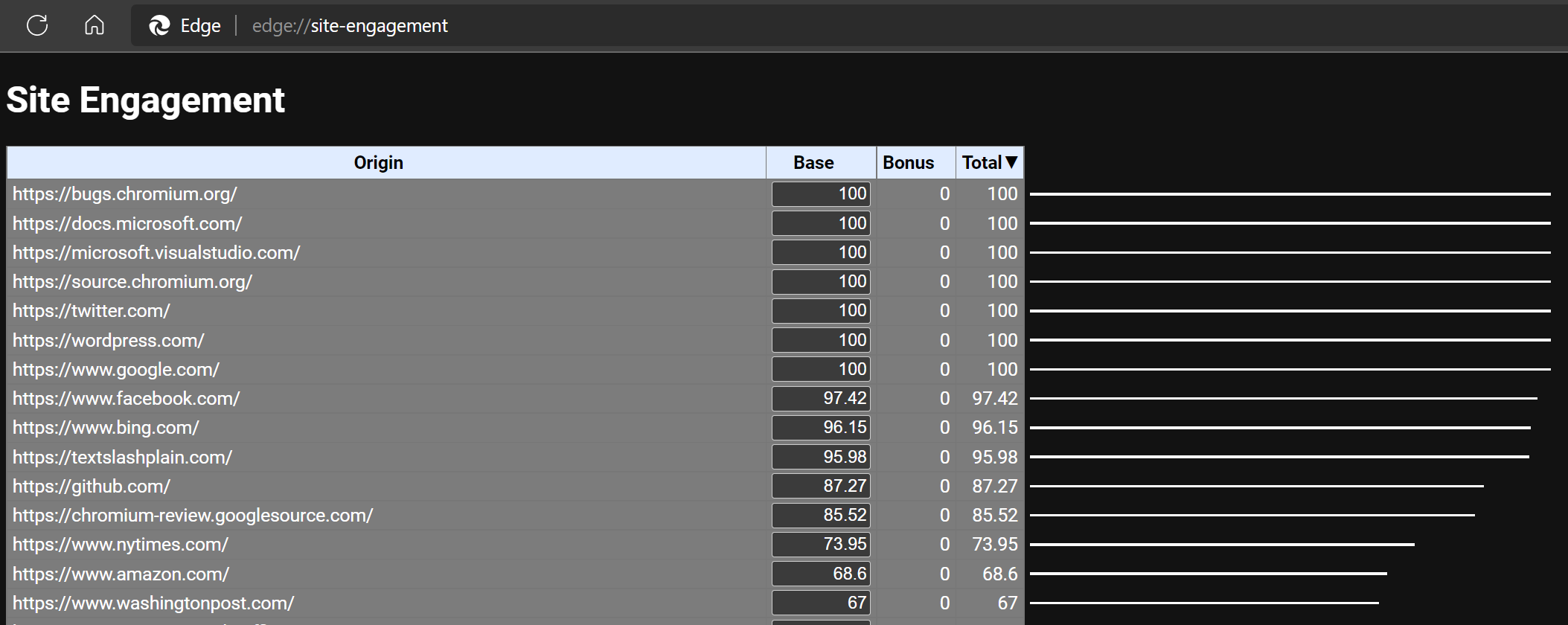
You can easily see your browser’s unique Engagement scores by visiting the url: about://site-engagement/. Here’s what mine looks like:

If you like, you can use the textboxes next to each site to manually adjust its score (e.g. for debugging).

A separate page, about://media-engagement/ tracks your engagement with Media content (e.g. video players).

The Site Engagement primitive can be used in many different features; for instance, it can weigh into things like:

  1. May Audio/video automatically start playback without a user-gesture?
  2. Should Tracking Prevention’s “Balanced mode” block a potential tracker?
  3. Should a permission prompt be presented as a balloon, or a more subtle icon in the toolbar?
  4. Should an “International Domain Name” be displayed in (potentially misleading) Unicode, or should it show in Punycode?

Site Engagement is a more robust mechanism than User Activation, but it’s still just a heuristic that can suffer from both false negatives (e.g. I’m using InPrivate or have just cleared my history, and am now visiting a trusted site) and false positives (a site has tricked me into engaging over time and now starts abusive behavior). As such, each feature’s respect for Site Engagement must be carefully considered, and recovery from false-negatives and false-positives must be simple.

Bespoke Mechanisms

Beyond User Activation and User Gesture requirements, various other signals have been proposed or used as clues into what behavior the user wants.

In determining whether a given file download is likely to be desired, for instance, the Downloads code uses a Familiar Initiator heuristic, which treats downloads as less suspicious if the originator of the Download request is a site that the user has visited before the current date.

Other features have considered such signals as:

  1. Is the site one that the user visited by navigating via the address bar (as opposed to navigations triggered by script)
  2. Is the site’s origin amongst the user’s Bookmarks/Favorites?
  3. Is the site an installed PWA?
  4. Do other users of a given site often respond to a particular permission decision in a particular way (aka “Cloud Consent”)? This approach is used in Adaptive Notifications.

Impact on Debugging

One downside of all of these mechanisms is that they can make debugging harder for folks like me– what you saw on your browser might not be what I see on mine, and what you experienced yesterday might not be what you experience tomorrow.

Tools like the about:site-engagement page can allow me to mimic some of your configuration, but some settings (e.g. the Familiar Initiator heuristic, or the timing of your User Gestures) are harder to account for.

That said, while smarter browsers are somewhat harder to debug, they can be much more friendly for end-users.

-Eric

PS: Browser designers must carefully consider how Site Engagement may result in web-visible side-effects. For example, can another site infer whether a given user is a frequent visitor to a site based on how the browser behaves?

1 A few settings inherit from Windows Security Zones.

Mid-February Checkin

tl;dr: On track.

Back in January, I wrote about my New Years’ Resolutions. I’m now 45 days in, and things are going pretty well.

  • Health and Finance: A dry January. Dry January has turned into dry February. Beyond idle thoughts “What should I do right now? In the old days, I’d pour myself a drink” and ten tough seconds (someone opened a delicious-smelling bottle of wine), I haven’t missed alcohol at all.
  • Health: Track my weight and other metrics. Done. I’m weighing in on my smart scale twice a week. I have a blood pressure cuff now; I haven’t been using it very regularly though. All metrics are headed in the right direction.
  • Health: Find sustainable fitness habits. Going great. I’ve bought a fancy treadmill and started using it, along with the exercise bike I bought in August 2020 and haven’t used until now. I’m working out at least 5 days a week for an hour or more. I also signed up for the Austin Capitol 10K in April, although I expect to walk a lot of it.
  • Travel: Haven’t yet booked an Alaska cruise, but it’s still on the back burner. I did book a near-repeat of the Christmas cruise for me and the kids over Spring break, and I’ve made some progress on bigger travel plans.
  • Finance: Spend more intentionally. Between the treadmill and the cruise, I’ve spent a lot of money so far in 2022, but for the most part it doesn’t feel wasted. The stock market hasn’t been doing too well, so I’m not feeling super-duper secure here.
  • Life: Produce more. I haven’t done a ton of this, beyond blogging and working on tools. I’m trying Hello Fresh, which has been educational and interesting– I’ve not really cooked anything remotely fancy before. I’ve also made some progress on delayed and on-going house projects though.

Sadly, work has not been going great, but everything else in life seems to be considerably better than a few months ago.

MHTML in Chromium

The MHTML file format (aka “Webpage, single file”) allows a single file to contain the multiple resources that are used to load a webpage (script, css, images, etc).

Edge (Chromium) has an option to use the format when saving the current page via Ctrl+S or the Save page as... menu command:

Saving MHTML from Save Page As…

… but the browser’s code has limited support for the MHTML format, meaning that it often cannot render files that it itself did not create, and even when loading files that it did create, there are several intentional restrictions.

Restriction: No Script

Reloading a saved MHTML file in Edge/Chrome/Chromium/etc will disable script.

Interestingly, when Chromium saves an MHTML file, it omits the <script> and <noscript> blocks entirely. If you saved the MHTML file from another tool that included script, when reloaded in Chromium, its script is not executed and a notice is shown in the Developer Tools Console:

Restriction: Disabled Forms

When loading a MHTML file, form controls like text fields and buttons are disabled, preventing the user from filling or submitting a form:

Restriction: Resources May not load

Chromium uses very restrictive rules for Same-Origin-Policy evaluation that can often prevent embedded resources (including images and stylesheets from loading) properly, leading to missing content and console warnings:

Limitation: Encodings

Internet Explorer’s MHTML component supported a variety of content-encodings that are not supported in Chromium. I fixed one bug but there are numerous other limitations in MHTML support.

Workaround: IEMode

If you need to load legacy MHTML content to load in Edge, your best bet is to configure the file to load in IEMode.

Edge includes some code which attempts to automatically detect whether a given MHTML file is compatible with Edge mode, e.g. checking for a Saved by Blink marker:

UPDATE: Note that opening MHT files in Internet Explorer represents a large attack surface, because it means that a bad actor could send a victim a malicious MHT file that exploits a 0-day in Internet Explorer.

If the victim opens the downloaded MHT and it switches to load in IE Mode automatically, the attacker could possibly escape the weaker IE sandbox and cause havoc. As of Edge 118, a downloaded MHT file (identified by a Zone.Identifier alternate data stream, aka mark of the web) will not open in IE Mode automatically unless a new group policy is enabled to accept the security risk.

-Eric

Adding Protocol Schemes to Chromium

Previously, I’ve written a lot about Application Protocols, which are a simple and popular common mechanism for browsers to send a short string of data out to an external application for handling. For instance, mailto is a common example of a scheme treated as an Application Protocol; if you invoke mailto:someone@somewhere.com, the browser will convert this to an OS execution of e.g.:

outlook.exe mailto:someone@somewhere.com

Application Protocols are popular because they are simple, work across most browsers on most operating systems, and because they can be added by 3rd parties without changes to the browser.

However, Application Protocols have one crucial shortcoming– they cannot directly return any data to the browser itself. If you wanted to do something like:

<img src='myScheme://photos/mypic.png' />

… there’s no straightforward way for your application protocol to send data back into the browser to render in that image tag.

You might be thinking: “Why can’t I, a third-party, simply provide a full implementation of a protocol scheme, such that my object gets a URL, and it returns a stream of bytes representing the data from that URL, just like HTTP and HTTPS do?

Asynchronous Pluggable Protocols

Back in the early days of Internet Explorer (1990s), the team didn’t know what protocols would turn out to be important. So, they built a richly extensible system of “Asynchronous Pluggable Protocols” (APP) which allowed COM objects to supply a full implementation of a protocol. The browser, upon seeing a URL (“moniker”) would parse the URL Scheme out, then “bind” to the APP object and send/receive data from that object. This allowed Internet Explorer to handle URLs in an abstract way and support a broad range of protocols (e.g. ftp, file, gopher, http, https, about, mailto, etc).

In many cases, we think only about receiving data from a protocol, but it’s important to remember that you can also send data (beyond the url) to a protocol; consider a file upload form that uses the POST method to send a form over HTTPS, for example.

Writing an APP was extremely challenging, and very risky– because APPs are exposed to the web, a buggy APP could be exploited by any webpage, and thanks to the lack of sandboxing in early IE, would usually result in full Remote Code Execution and compromise of the system. Beyond the security concerns, there were reliability challenges as well– writing code that would properly handle the complex threading model of a browser downloading content for a web page was very difficult, and many APP implementations would crash or hang the browser when conditions weren’t as the developer expected.

Despite the complexity and risk, writing APPs provided Internet Explorer with unprecedented extensibility power. “Back in the day” I was able to do some fun things, like add support for data: URLs to IE7 before the browser itself got around to supporting such URLs.

Understanding Custom Schemes

Sending a URL to into an APP object and getting bytes back from a stream is only half of the implementation challenge, however.

The other half is figuring out how the rest of the browser and web platform should handle these URLs. For Internet Explorer, we had a mechanism that allowed the host (browser) to query the protocol about how its URLs should be handled. The IInternetProtocolInfo interface allowed the APP’s code to handle the comparison and combination of URLs using its scheme, and allowed the code to answer questions about how web content returned from the URL should behave.

For instance, to fully support a scheme, the browser needs to be able to answer questions like:

  1. Is this scheme “standard” (allowing default canonicalization behaviors like removing \..\ sequences), or “opaque” (in which other components cannot safely touch the URL)?
  2. Is this scheme “Secure” (Allow in HTTPS pages without mixed content warnings, allow WebAPIs that require a secure context, etc)
  3. Does this scheme participate in CORS?
  4. Does this scheme get sent as a referrer?
  5. Is this scheme allowed from Sandboxed frames?
  6. Can top-level frames be navigated to this scheme?
  7. Can such navigations only occur from trusted contexts (app/omnibox) or is JavaScript allowed to invoke such navigations?
  8. How do navigations to these urls interact with all of the other WebNavigation/WebRequest extensibility APIs?
  9. How does the scheme interact with the sandbox? What process isolation is used?
  10. What origin is returned to web content running from the scheme?
  11. How does content from the scheme interact with the cookie store?
  12. How does it interact with CSP?
  13. How does it interact with WebStorage?

Implementing Protocols in Chromium

Unlike Internet Explorer, Chromium does not offer a mechanism for third-party extensibility of its protocols; the browser itself must have support for a new protocol compiled in. A subclassed URLLoaderFactory (e.g. about, blob) invokes the correct url_loader implementation that returns the data for the response.

Chromium doesn’t have an analogue for the IInternetProtocolInfo interface for protocol implementors to implement; instead, the scheme must be manually added to each of the per-behavior lists of schemes hardcoded into Chromium.

Brave documented some of the work they needed to do to add a protocol to their Chromium-based browser.